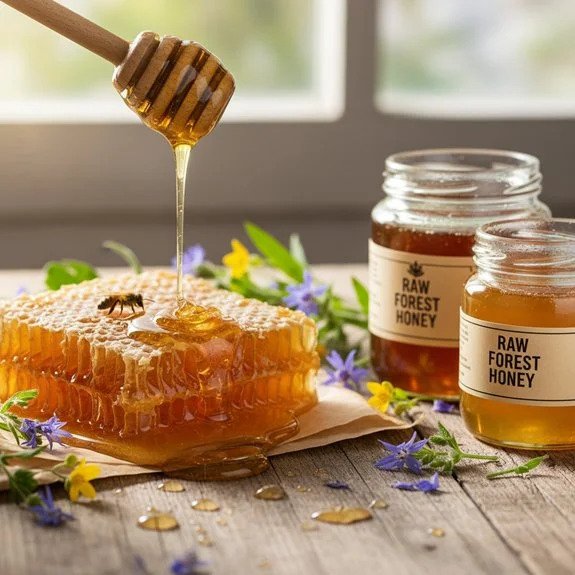
Spotting Real Versus Fake North Texas Honey on Store Shelves
Compare labels carefully and consider local sources—can you tell real North Texas honey from imposters? Discover the telltale signs inside.
September 29, 2025 •
10 min read
Think you’re grabbing real North Texas honey but end up with syrupy imposters? Look for clear labels showing **local origin**, no added sugars, and check for **natural crystallization**—it’s a sign your honey’s genuine and raw. Avoid super cheap bottles; they often hide fillers like corn syrup or water. Plus, **supporting local beekeepers** means tastier honey that truly reflects North Texas blooms. Want to avoid the fakes? Keep paying attention—you’ll soon spot the genuine article with ease.
## Key Takeaways
- Check for clear labeling specifying North Texas origin and certification stamps to ensure authenticity and local sourcing.
- Verify the ingredients list contains only pure honey with no added sugars, syrups, or artificial additives.
- Avoid extremely low-priced honey, which often indicates dilution with fillers like corn syrup or molasses.
- Look for "raw" or "unfiltered" claims supported by harvest dates and producer transparency about beekeeping practices.
- Prefer honey from local beekeepers sold at farmers’ markets or local stores who prioritize sustainable, honest production.
<div class="grid grid-cols-1 md:grid-cols-2 lg:grid-cols-3 gap-8 not-prose my-12">
<div class="bg-white rounded-xl shadow-md border border-gray-100 flex flex-col h-full hover:shadow-xl transition-all duration-300 transform hover:-translate-y-1" style="border-color: #bfdbfe;">
<div class="w-full aspect-square relative overflow-hidden group rounded-t-xl">
<img src="/public/assets/uploads/69a20f508775b.jpg"
class="w-full h-full object-cover transition duration-500 group-hover:scale-105" alt="Cover">
<div
class="absolute top-0 right-0 bg-yellow-400 text-yellow-900 text-xs font-bold px-3 py-1 rounded-bl shadow-sm z-10">
FEATURED </div>
</div>
<div class="p-6 flex-grow flex flex-col">
<div class="flex items-center gap-4 mb-4">
<img src="/public/assets/uploads/69a20f5087597.png"
class="w-16 h-16 object-contain border rounded bg-gray-50 p-1" alt="Logo">
<div>
<div class="flex flex-wrap gap-2 mb-1">
<span class="text-[11px] font-bold px-2 py-1 rounded uppercase tracking-wide"
style="color: #1d4ed8; background-color: #e0f2fe; border: 1px solid #bfdbfe;">
North Texas </span>
<span
class="text-[11px] font-bold text-black bg-white border border-black px-2 py-1 rounded tracking-wide">
Anna, TX </span>
</div>
<h3 class="text-xl font-bold leading-tight m-0" style="color: #1d4ed8;">
<a href="/listings/crooked-creek-honey-farm" class="hover:underline">
Crooked Creek Honey Farm </a>
</h3>
<!-- Rating -->
<div class="flex items-center gap-1 mt-1">
<div class="flex text-yellow-400">
<svg class="w-4 h-4 fill-current" viewBox="0 0 20 20">
<path
d="M9.049 2.927c.3-.921 1.603-.921 1.902 0l1.07 3.292a1 1 0 00.95.69h3.462c.969 0 1.371 1.24.588 1.81l-2.8 2.034a1 1 0 00-.364 1.118l1.07 3.292c.3.921-.755 1.688-1.54 1.118l-2.8-2.034a1 1 0 00-1.175 0l-2.8 2.034c-.784.57-1.838-.197-1.539-1.118l1.07-3.292a1 1 0 00-.364-1.118L2.98 8.72c-.783-.57-.38-1.81.588-1.81h3.461a1 1 0 00.951-.69l1.07-3.292z" />
</svg>
<svg class="w-4 h-4 fill-current" viewBox="0 0 20 20">
<path
d="M9.049 2.927c.3-.921 1.603-.921 1.902 0l1.07 3.292a1 1 0 00.95.69h3.462c.969 0 1.371 1.24.588 1.81l-2.8 2.034a1 1 0 00-.364 1.118l1.07 3.292c.3.921-.755 1.688-1.54 1.118l-2.8-2.034a1 1 0 00-1.175 0l-2.8 2.034c-.784.57-1.838-.197-1.539-1.118l1.07-3.292a1 1 0 00-.364-1.118L2.98 8.72c-.783-.57-.38-1.81.588-1.81h3.461a1 1 0 00.951-.69l1.07-3.292z" />
</svg>
<svg class="w-4 h-4 fill-current" viewBox="0 0 20 20">
<path
d="M9.049 2.927c.3-.921 1.603-.921 1.902 0l1.07 3.292a1 1 0 00.95.69h3.462c.969 0 1.371 1.24.588 1.81l-2.8 2.034a1 1 0 00-.364 1.118l1.07 3.292c.3.921-.755 1.688-1.54 1.118l-2.8-2.034a1 1 0 00-1.175 0l-2.8 2.034c-.784.57-1.838-.197-1.539-1.118l1.07-3.292a1 1 0 00-.364-1.118L2.98 8.72c-.783-.57-.38-1.81.588-1.81h3.461a1 1 0 00.951-.69l1.07-3.292z" />
</svg>
<svg class="w-4 h-4 fill-current" viewBox="0 0 20 20">
<path
d="M9.049 2.927c.3-.921 1.603-.921 1.902 0l1.07 3.292a1 1 0 00.95.69h3.462c.969 0 1.371 1.24.588 1.81l-2.8 2.034a1 1 0 00-.364 1.118l1.07 3.292c.3.921-.755 1.688-1.54 1.118l-2.8-2.034a1 1 0 00-1.175 0l-2.8 2.034c-.784.57-1.838-.197-1.539-1.118l1.07-3.292a1 1 0 00-.364-1.118L2.98 8.72c-.783-.57-.38-1.81.588-1.81h3.461a1 1 0 00.951-.69l1.07-3.292z" />
</svg>
<svg class="w-4 h-4 fill-current" viewBox="0 0 20 20">
<path
d="M9.049 2.927c.3-.921 1.603-.921 1.902 0l1.07 3.292a1 1 0 00.95.69h3.462c.969 0 1.371 1.24.588 1.81l-2.8 2.034a1 1 0 00-.364 1.118l1.07 3.292c.3.921-.755 1.688-1.54 1.118l-2.8-2.034a1 1 0 00-1.175 0l-2.8 2.034c-.784.57-1.838-.197-1.539-1.118l1.07-3.292a1 1 0 00-.364-1.118L2.98 8.72c-.783-.57-.38-1.81.588-1.81h3.461a1 1 0 00.951-.69l1.07-3.292z" />
</svg>
</div>
<span class="text-xs text-gray-600 font-bold">5</span>
<span class="text-xs text-gray-500">(12978 reviews)</span>
</div>
<div class="text-sm text-gray-500 mt-1 flex items-start gap-1">
<svg class="w-4 h-4 flex-shrink-0 mt-0.5" fill="none" stroke="currentColor" viewBox="0 0 24 24">
<path stroke-linecap="round" stroke-linejoin="round" stroke-width="2"
d="M17.657 16.657L13.414 20.9a1.998 1.998 0 01-2.827 0l-4.244-4.243a8 8 0 1111.314 0z">
</path>
<path stroke-linecap="round" stroke-linejoin="round" stroke-width="2"
d="M15 11a3 3 0 11-6 0 3 3 0 016 0z"></path>
</svg>
<div class="leading-tight">
<div>12992 County Road 577</div>
<div>Anna, Texas 75409</div>
</div>
</div>
</div>
</div>
<!-- Testimonial -->
<div class="mb-4 bg-gray-50 p-3 rounded border-l-4 border-yellow-400 text-sm text-gray-600 italic">
"This is by far the best honey I've ever had! We found them last year at Salsa Fest and have been hooked every since. The owners are so knowledgeable and seem really passionate about what they do. This is the only honey we'll buy now!"
</div>
<!-- Gallery -->
<div class="grid grid-cols-4 gap-2 mb-4">
<div class="aspect-square rounded overflow-hidden border bg-gray-100">
<img src="/public/assets/uploads/69a20f5091c8b_001.jpg"
class="w-full h-full object-cover" alt="Gallery">
</div>
<div class="aspect-square rounded overflow-hidden border bg-gray-100">
<img src="/public/assets/uploads/69a20f50926f0_002.jpg"
class="w-full h-full object-cover" alt="Gallery">
</div>
<div class="aspect-square rounded overflow-hidden border bg-gray-100">
<img src="/public/assets/uploads/69a20f5092ff5_003.jpg"
class="w-full h-full object-cover" alt="Gallery">
</div>
<div class="aspect-square rounded overflow-hidden border bg-gray-100">
<img src="/public/assets/uploads/69a20f50938e4_004.jpg"
class="w-full h-full object-cover" alt="Gallery">
</div>
</div>
<div class="text-gray-600 mb-6 flex-grow text-sm">
We are a family of local beekeepers who are passionate about the health of our bees and the quality of our honey. </div>
<div class="mt-auto pt-6 border-t space-y-2">
<div class="flex items-center gap-2 text-sm font-semibold text-gray-700 mb-3">
<svg class="w-5 h-5 text-green-500" fill="none" stroke="currentColor" viewBox="0 0 24 24">
<path stroke-linecap="round" stroke-linejoin="round" stroke-width="2"
d="M13 7h8m0 0v8m0-8l-8 8-4-4-6 6"></path>
</svg>
<span>563 North Texans recently bought their honey</span>
</div>
<div class="flex items-center gap-2 text-sm">
<svg class="w-4 h-4 text-gray-400" fill="none" stroke="currentColor" viewBox="0 0 24 24">
<path stroke-linecap="round" stroke-linejoin="round" stroke-width="2"
d="M3 5a2 2 0 012-2h3.28a1 1 0 01.948.684l1.498 4.493a1 1 0 01-.502 1.21l-2.257 1.13a11.042 11.042 0 005.516 5.516l1.13-2.257a1 1 0 011.21-.502l4.493 1.498a1 1 0 01.684.949V19a2 2 0 01-2 2h-1C9.716 21 3 14.284 3 6V5z">
</path>
</svg>
<a href="tel:972-542-4419" class="hover:text-blue-600 transition"
data-track-id="1"
data-track-type="phone">972-542-4419</a>
</div>
<div class="flex items-center gap-2 text-sm">
<svg class="w-4 h-4 text-gray-400" fill="none" stroke="currentColor" viewBox="0 0 24 24">
<path stroke-linecap="round" stroke-linejoin="round" stroke-width="2"
d="M3 8l7.89 5.26a2 2 0 002.22 0L21 8M5 19h14a2 2 0 002-2V7a2 2 0 00-2-2H5a2 2 0 00-2 2v10a2 2 0 002 2z">
</path>
</svg>
<a href="mailto:lisa@cchfbees.com" class="hover:text-blue-600 transition"
data-track-id="1"
data-track-type="email">lisa@cchfbees.com</a>
</div>
<div class="flex items-center gap-2 text-sm">
<svg class="w-4 h-4 text-gray-400" fill="none" stroke="currentColor" viewBox="0 0 24 24">
<path stroke-linecap="round" stroke-linejoin="round" stroke-width="2"
d="M10 6H6a2 2 0 00-2 2v10a2 2 0 002 2h10a2 2 0 002-2v-4M14 4h6m0 0v6m0-6L10 14"></path>
</svg>
<a href="https://cchfbees.com/" target="_blank"
class="hover:text-blue-600 transition" data-track-id="1"
data-track-type="website">Visit Website</a>
</div>
<div class="pt-3 flex gap-2">
<a href="javascript:void(0)"
class="message-link inline-flex items-center gap-1 px-3 py-1.5 rounded bg-green-600 text-white text-xs font-semibold hover:bg-green-700 transition"
data-business-id="1" data-lead-type="message" data-no-popup="true"
title="Send a Message">
<svg class="w-3.5 h-3.5" fill="none" stroke="currentColor" viewBox="0 0 24 24">
<path stroke-linecap="round" stroke-linejoin="round" stroke-width="2"
d="M8 10h.01M12 10h.01M16 10h.01M9 16H5a2 2 0 01-2-2V6a2 2 0 012-2h14a2 2 0 012 2v8a2 2 0 01-2 2h-5l-5 5v-5z">
</path>
</svg>
Message
</a>
</div>
</div>
</div>
</div> </div>
## Understanding the Source of North Texas Honey
Before you grab that jar of honey at your local North Texas market, have you ever wondered where it really comes from? Understanding the **honey origin** is key to appreciating what’s on your shelf. Real North Texas honey is a product of the **local flora**—the wildflowers, trees, and plants buzzing with bees around your neighborhood. These plants give the honey its **unique taste** and color, reflecting the region’s natural beauty. But can you tell if the honey truly comes from these **local sources**? It’s not always obvious, and that’s where things get tricky. When honey isn’t sourced locally, it often lacks the distinct flavor that North Texas’s native plants provide. So, knowing the honey origin means you’re not just buying sweetness—you’re **supporting freedom** in your food choices, embracing nature’s bounty, and resisting the bland uniformity of **mass-produced products**. Isn’t that worth a closer look?
## Identifying Local Beekeepers and Their Practices
Knowing where your **honey comes from** is just the start; the next step is figuring out who’s behind the jar. You want to **support honest local beekeepers** who respect their bees and the environment. So, how do you spot them? Focus on these clues about their beekeeping practices and local hives:
> Support local beekeepers who care for their bees and environment by knowing their honest practices and origins.
- They keep their hives in North Texas, ensuring the honey reflects local flora.
- Transparent about their methods—no shortcuts or additives.
- Practice **sustainable beekeeping**, prioritizing bee health over mass production.
- Engage with their community, often selling directly at **farmers’ markets** or local stores.
- Open to **questions about their hives** and honey extraction processes.
## Reading and Interpreting Honey Labels Correctly
Ever stared at a **honey jar** and wondered what all those fancy words really mean? Labels can be tricky, but knowing key indicators and decoding honey terminology will help you spot the real deal. Ready to become a **label-reading pro** and avoid getting fooled?
### Key Label Indicators
You might think reading a **honey label** is as simple as glancing at the name, but there’s more to it than meets the eye. To truly spot real North Texas honey, you need **label transparency** and **honey certification**. These are your freedom tools against **fake products**. So, what should you look for?
- Clear indication of the honey’s origin
- Certification stamps from trusted organizations
- Ingredients list with no added sugars or syrups
- Harvest date or best-by date for freshness
- Claims like “raw” or “unfiltered” backed by proof
### Decoding Honey Terminology
While **honey labels** might seem straightforward, they often hide a buzz of **confusing terms** that can leave you scratching your head. Ever wonder what all those words like “pure,” “raw,” or “filtered” really mean? Understanding honey terminology isn’t just a party trick—it’s key to spotting **genuine North Texas honey**. Honey classifications can vary widely, and brands might use fancy labels to make their jars sound more appealing than they actually are. So, how do you read between the lines? Look for clear information about the source and processing methods. If a label’s vague or overloaded with marketing speak, it’s a **red flag**. You deserve freedom to choose real honey, not a sugary imposter masked by clever honey terminology.
## Recognizing Common Additives and Fillers in Honey
Although honey naturally tastes sweet and pure, some products on the market sneak in additives and fillers that can fool even the sharpest eye. When you shop, practicing **additive awareness** and **filler identification** is key to **protecting your freedom** to choose **genuine North Texas honey**. So, what should you watch out for? Here are common culprits:
- Corn syrup or glucose syrup, which dilute purity
- Cane sugar or beet sugar, **cheap sweeteners** hiding in plain sight
- Molasses, which darkens and alters flavor
- Water, added to stretch volume but reduce quality
- Artificial flavors or colors, masking inferior honey
Doesn’t it make you wonder why anyone would mess with nature’s golden goodness? By knowing these tricks, you gain power over your choices and **support honest beekeepers**. So next time you reach for that jar, ask yourself: am I getting real honey or a cleverly disguised copy? Your taste buds—and your freedom—deserve the truth.
## The Importance of Honey Crystallization as a Quality Indicator
Crystallization in honey often sparks debate—does it mean the honey's **gone bad**, or is it a sign of quality? Actually, the crystallization process is a **natural occurrence** and can be a useful **quality assessment tool**. When honey crystallizes, it’s simply sugar molecules forming solid crystals, which happens faster in **pure, raw honey**. So, if your honey starts to look grainy or cloudy, it’s not a problem—it’s a sign that you’re likely dealing with **authentic honey**. Fake or heavily processed honey tends to stay liquid longer because additives interfere with this natural process. You might wonder, “Does crystallized honey taste different?” Not really, just a bit thicker and spreadable. Embracing this change means you’re enjoying honey closer to its natural state. Next time you see crystallized honey on the shelf, don’t shy away—think of it as a **badge of honor** for genuine quality. After all, freedom means knowing what’s real and what’s not.
## Price Points and What They Reveal About Authenticity
You’ve probably noticed that **honey prices** can vary a lot, and that’s not just about branding or packaging. When you’re making a price comparison, it’s easy to think cheaper means a better deal, but with honey, that’s often a red flag. Real North Texas honey tends to have a fair price reflecting the effort of **local beekeepers**. **Consumer education** helps you spot when a bargain might actually be fake or mixed honey. Here’s what price points can reveal:
- Extremely low prices often signal additives or syrups.
- Mid-range prices usually indicate **genuine local honey**.
- High prices may reflect **premium, raw, or specialty varieties**.
- Sudden discounts on honey can mean overstocked or less authentic batches.
- Comparing prices across stores helps you avoid paying too much or getting fooled.
## Where to Buy Genuine North Texas Honey Safely
Wondering where to find genuine North Texas honey without getting tricked? Your best bet is to stick with trusted local markets and reputable online shops. These places usually vet their suppliers carefully, so you’re less likely to get duped by fake honey. Plus, local markets give you the freedom to chat directly with beekeepers or sellers, asking all the questions you want.
Here’s a quick guide to help you pick the right spot:
| Buying Location | Benefits | Tips |
|-------------------|----------------------------|--------------------------|
| Farmers Markets | Fresh, local, direct talk | Ask about hive location |
| Specialty Stores | Curated selections | Check for certification |
| Online Shops | Convenience, variety | Read reviews carefully |
| Grocery Stores | Easy access | Look for local labels |
| Beekeepers’ Co-ops| Authentic and transparent | Visit if possible |
Choosing wisely means your honey jar stays true to North Texas, giving you pure sweetness without compromise.
## Frequently Asked Questions
### How Does the Taste of North Texas Honey Differ From Other Regional Honeys?
You’ll notice North Texas honey has **unique taste profiles** compared to other regional honeys. It’s often bolder, with **floral and earthy notes** that reflect local wildflowers and climate. Ever wondered why honey from the same country tastes different? That’s regional differences at work—bees pick up nectar from native plants, shaping flavor. So, if you crave freedom in flavor, North Texas honey offers a **distinct, rich experience** you won’t find just anywhere.
### Can North Texas Honey Have Medicinal Properties Unique to the Area?
Absolutely, North Texas honey can have unique **medicinal benefits** because it reflects the **local flora** your bees visit. This means it might carry specific antioxidants or antibacterial properties tied to plants only found in that region. Ever wonder if your honey could help **soothe a sore throat** or boost immunity just because of where it’s made? That’s the power of nature’s local touch—pretty cool, right?
### What Flowers Do North Texas Bees Primarily Forage On?
North Texas bees mainly forage on local flora like bluebonnets, mesquite, and wildflowers. Ever wonder why your honey tastes unique? That’s **bee foraging** at work, as these plants give the honey **distinct flavors** and qualities. You get to enjoy a **natural mix** crafted by the bees’ freedom to roam. So next time you savor that honey, think about the flowers behind the sweetness—it’s nature’s own recipe, no shortcuts.
### How Long Does North Texas Honey Typically Last Before Spoiling?
North Texas honey typically lasts indefinitely if stored right, thanks to its natural preservatives. You might wonder, how does **honey storage** affect spoilage? Keep it in a cool, dry place, sealed tight. Look out for **spoilage signs** like fermentation bubbles or off smells—rare but possible if moisture sneaks in. So, don’t rush to toss your jar; real honey’s **shelf life** is a sweet proof of nature’s brilliance.
### Are There Seasonal Variations in North Texas Honey Production?
Yes, you’ll notice clear **seasonal trends** in North Texas honey production. Spring and early summer usually bring the highest **honey yields**, thanks to **wildflowers and blooming trees**. But, as the seasons shift, production slows down—kind of like nature’s way of taking a break. Ever wonder why honey varies throughout the year? It’s all about the flowers bees visit, which change with the seasons. Pretty cool, right?
## Conclusion
Now that you know how to spot **real North Texas honey**, don’t let a **slick label** fool you—after all, you can’t judge a book by its cover. By checking sources, reading labels carefully, and watching for natural signs like crystallization, you’re armed to make **smart choices**. So, next time you’re at the store, ask yourself: is this honey the real deal or just a sweet imitation? Your taste buds—and your health—will thank you!
Related Searches in nearby areas
- Warne Bee Farm Anna
- natural allergy relief Texas
- local beekeepers Adkins
- local honey online order dallas texas
- local raw honey delivery Anna TX
- best apiaries selling raw honey Gainesville TX
- East Texas honey producers
- local honey benefits in denton tx
- where to buy local honey in Canton TX
- where to buy raw honey in Anna TX
- Maxwell Family Bees honey
- buy honey from farm Arlington
- unfiltered honey Arlington
- raw honey Gainesville Texas
- difference between raw and processed honey
- buy raw honey Arlington TX
- North Texas local honey
- Anderson County beekeepers
- how to use honey for pollen allergies
- Texas honey farm tours near me
- where to buy raw honey in Alamo Heights TX
- Juniperus ashei pollen desensitization
- real Texas honey Aledo
- Real Texas Honey East Texas
- north texas wildflower honey sellers
- where to buy Texas honey
- local honey benefits for allergies mckinney tx
- local raw honey delivery Alvin TX
- buy raw honey North Texas
- best honey for ragweed allergies
- Edelweiss Apiary honey
- raw honey sellers Baird Texas
- local honey delivery plane texas
- cedar fever treatment Texas
- local apiaries selling honey collin county
- Adkins TX honey farm
- buy local honey Collin County
- how does local honey help allergies texas
- local honey vs antihistamines
- local raw honey delivery Alamo Heights TX
- Alamo Heights TX beekeepers
- Gopher Knoll Farm honey
- who sells raw honey Baird TX
- Bartonville TX beekeepers
- local honey for Texas allergies
- raw honey sellers Anna Texas
- buy raw honey direct Baird TX
- where to buy raw honey in Weatherford TX
- Pete Glasser honey Texas
- Aledo Apiary services
- visit apiaries Collin County
Trending Searches in nearby areas
- Texas beekeepers raw honey sources
- warne bee farms cold extraction method
- support local beekeepers Anna
- unfiltered honey Anna TX
- unfiltered honey Weatherford
- Maxwell Family Bees Anderson County
- Warne Bee Farm Anna honey
- Callahan County honey
- natural allergy relief honey Texas
- local honey Cooke County
- best raw honey Aledo TX
- texas cottage food law honey sellers
- Texas Bee Ranch certified
- honey producers Bandera
- unfiltered honey McKinney Texas
- unfiltered honey North Texas
- farm-to-table honey fort worth tx
- family owned bee farms Texas
- north texas allergy pollen forecast
- unprocessed honey adkins
- Green Hands Farm honey
- unfiltered honey Texas
- Anna Collin County honey
- ordering honey online Blue Ridge TX
- texas allergy season 2024
- natural allergy remedies for Houston
- North Texas local honey producers
- allergy relief honey Weatherford
- north texas spring allergy conditions
- Cornerstone Honey Bees Bryan
- honey for cedar pollen sensitivity
- Dovetail Creek honey Bartonville
- support local beekeepers Arlington
Top Recommendations in nearby areas
- Texas honey directory
- Texas raw honey suppliers
- north texas apiary liability insurance
- support local beekeepers Bryan
- north texas local honey for digestion
- artisan honey Baird
- north texas monofloral honey uses
- honey comb Alamo Heights
- how to spot real north texas honey
- fresh raw honey Anna TX
- best honey stores Anna
- Gopher Knoll Farm honey
- when to use honey for allergies
- fresh honey delivery Alamo Heights
- local beekeepers in Anna Texas
- benefits of raw honey dallas area
- allergies local honey
- wildflower honey flavors Bartonville
- honeycomb gifts Anderson County
- safety of honey for adults
- honey beekeepers Baird
- fresh raw honey bexar county
- natural allergy relief honey fort worth
- raw honey immune support north texas
- native plants honey flavor
- Texas allergy season honey remedy
- fresh honey harvest Gainesville
- fresh wildflower honey Aledo
- Master Beekeeper Texas A&M
- North Texas honey producers
- Texas ragweed allergy remedies
- honey for allergy relief Texas
- raw honey delivery Arlington