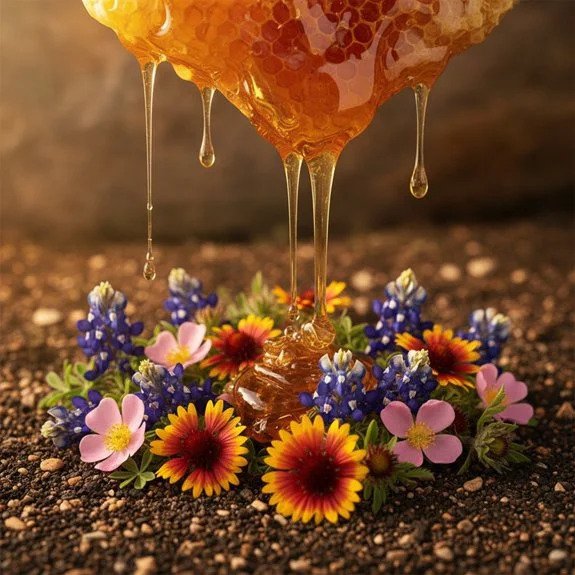
How North Texas Soil and Flowers Shape Unique Honey Flavors
How do North Texas soils and wildflowers blend to create honey with uniquely rich flavors? Discover the secret behind every sweet drop.
November 3, 2025 •
19 min read
Ever wonder why **North Texas honey** tastes so distinct? It all starts with the soil—clay holds moisture steady, helping **wildflowers thrive**, while sandy loam keeps roots happy and flowers vibrant. Bees feast on blooms like bluebonnets, Indian paintbrush, and black-eyed Susans, each adding a unique flavor twist. This rich mix creates **multiflora honey** bursting with layered sweetness. Curious how soil, flowers, and bees team up to craft these delicious differences? You’re about to find out.
## Key Takeaways
- North Texas soil types like clay and sandy loam influence plant growth, affecting nectar quality and honey flavor.
- Diverse native wildflowers, including bluebonnets and Indian paintbrush, provide unique nectar sources that shape honey’s taste.
- Seasonal blooming patterns impact nectar availability, contributing to distinct honey flavors throughout the year.
- Multiflora honey from mixed wildflowers creates complex, layered flavors unique to different North Texas regions.
- Traditional beekeeping and local environmental factors preserve authentic honey flavors linked to soil and floral diversity.
## Overview of North Texas Soil Types
Soil might not be the first thing that comes to mind when you think about honey, but it plays a surprisingly big role in shaping the flavors you find in **North Texas** honey. You see, the type of soil influences what plants grow around, which then affects the **nectar** bees collect. North Texas soil types vary widely, creating a natural patchwork that supports **diverse wildflowers** and plants. When you care about **soil conservation**, you’re actually protecting this whole chain—from the ground beneath your feet to the honey in your jar. Maintaining **ecological balance** through healthy soil means bees have access to rich, varied flora, leading to complex, unique **honey flavors**. Ever wonder why honey from one part of North Texas tastes different from another? It’s the soil whispering its story through the flowers and, finally, the honey. So, respecting soil conservation isn’t just good for the earth; it’s a sweet deal for your taste buds too.
## Characteristics of Clay Soils in North Texas
Ever wonder how **clay soils** in North Texas shape the flowers that bees love? These soils are dense and hold water tightly, which can be both a blessing and a challenge for plant growth. So, how do these traits influence the flavors you find in **local honey**?
### Soil Composition and Texture
Although you might not give much thought to what's beneath your feet, the **clay soils** in North Texas play a big role in shaping the **flavors of local honey**. Have you ever wondered how **soil composition** affects honey’s taste? Clay soils hold **soil moisture** well, which helps flowers thrive during dry spells. But beware, if **soil erosion** occurs, it can strip away these essential nutrients. The texture is dense yet crumbly, creating a unique environment for plants. Here’s what you should know about North Texas clay soils:
- Retain water efficiently, supporting consistent soil moisture
- Resist soil erosion better than sandy soils
- Have fine particles that compact easily
- Create a stable base for diverse plant roots
- Influence **nutrient availability**, impacting nectar quality
Pretty impressive for some dirt, right?
### Impact on Flower Growth
You might not realize it, but the way flowers grow in North Texas owes a lot to those **clay soils** beneath them. Clay soils hold onto **soil moisture** longer than sandy soils, which means flowers get a steady water supply even when rains are scarce. This steady moisture influences **flowering cycles**, often stretching them out or making blooms more consistent. Ever wondered why some flowers seem to last longer here? That’s the clay soil at work. It keeps plants rooted and ready, but it can also challenge roots when it’s too dense or wet. So, understanding these soils helps you appreciate how **local flowers** adapt, thrive, and ultimately shape the **unique honey flavors** you enjoy. Who knew dirt could play such a starring role?
## Sandy Loam and Its Impact on Local Flora
Have you ever wondered how **sandy loam** shapes the plants around you? Its loose texture lets roots breathe and stretch, while nutrients flow just right for growth. Could this mix be the secret behind the unique flavors buzzing in **North Texas honey**?
### Soil Texture and Plant Growth
When you think about the soil beneath your feet, have you ever wondered how its texture shapes the plants growing above? **Sandy loam**, common in North Texas, offers a unique balance that lets roots breathe and soak up water just right. This texture encourages **plant adaptation**, helping native flora thrive despite dry spells. **Soil microorganisms** love sandy loam too—they break down organic matter, enriching the soil and supporting plant health.
Consider these benefits:
- Enhanced drainage prevents root rot
- Easy root penetration boosts growth
- Balanced moisture retention aids survival
- Active microorganisms improve nutrient cycling
- Supports diverse plant species’ adaptability
### Nutrient Availability Effects
Although **sandy loam** might seem like just a mix of sand and clay, its **nutrient availability** plays a surprisingly big role in shaping North Texas’ local flora. You might wonder, how does this soil type affect the plants that bees rely on? Well, sandy loam supports **efficient nutrient cycling**, thanks to its balanced texture that holds just enough organic matter to feed roots without drowning them. This means flowers thrive with steady access to essential nutrients, growing **vibrant and healthy**. When plants get the right nutrients, their nectar develops unique flavors, which bees then turn into the honey you enjoy. So next time you savor North Texas honey, remember—it’s not just the flowers but the sandy loam beneath them, quietly fueling **nature’s flavor magic**. Pretty cool, right?
## Native Wildflowers Unique to North Texas
Since North Texas boasts a **unique climate and soil**, you'll find wildflowers here that you won't spot anywhere else. These **native wildflowers** don’t just paint the landscape; they shape the very essence of **local honey** with their **distinctive** **seasonal blooms**. Ever wonder what gives that honey its special flair? It’s these flowers, blooming at different times, each adding its own flavor note.
Consider these native wildflowers unique to North Texas:
- Indian Paintbrush, with its fiery red petals
- Texas Lantana, bright and buzzing with bees
- Prairie Verbena, small but mighty and purple
- Mexican Hat, quirky with its spiky top
- Glowwort, lighting up the night with subtle charm
## Bluebonnets: Texas’ Iconic Nectar Source
Bluebonnets aren’t just pretty flowers—they’re a big deal when it comes to **honey** in Texas. Have you ever wondered what gives North Texas honey its **unique taste**? It’s partly thanks to those vivid bluebonnet blooms that blanket fields each spring. These flowers don’t just brighten the landscape; they offer essential bluebonnet benefits to the bees that buzz around them. When bees collect **nectar** from **bluebonnets**, they create honey with subtle **floral notes** you won’t find anywhere else.
Imagine tasting freedom in a jar—that’s what bluebonnet honey feels like. The soil and climate of Texas nurture these blooms, making their nectar distinctively rich. So next time you see a field of bluebonnets, remember, you’re looking at more than just a state symbol; you’re witnessing the roots of a truly **Texan flavor**. Isn’t it amazing how nature crafts such a sweet story?
## The Role of Indian Paintbrush in Honey Flavor
You might be surprised to learn that **Indian Paintbrush**, despite its **striking red and orange petals**, doesn’t actually play a significant role in the flavor of North Texas honey. While this wildflower adds vibrant color to the landscape and offers some Indian Paintbrush benefits, it’s not a major nectar source for bees. So, when you savor **local honey**, the **unique honey flavor profiles** come more from other flowers.
> Indian Paintbrush brightens landscapes but isn’t a key nectar source shaping North Texas honey flavors.
But why does Indian Paintbrush matter at all? Here’s the scoop:
- It **supports local ecosystems** by attracting pollinators other than honeybees.
- Its vivid hues enhance the natural beauty of meadows, inspiring freedom through nature’s palette.
- Though not a key nectar contributor, it symbolizes the wild spirit of North Texas flora.
- It offers **medicinal uses**, adding to its regional importance beyond honey flavor.
- Its presence hints at diverse soil types, indirectly influencing which flowers thrive and shape honey profiles.
## Influence of Black-eyed Susans on Honey Aroma
Have you ever noticed how **Black-eyed Susans** add a subtle floral twist to honey’s aroma? Their bright, cheerful blooms don’t just brighten fields—they also influence the scent you experience in each drop. Let’s explore how these sunny flowers shape the unique fragrance of **North Texas honey**.
### Floral Notes From Susans
Not many people realize just how much **black-eyed Susans** can **influence the taste** of honey in North Texas. When bees visit these vibrant flowers, their behavior shifts, and the **nectar diversity** they collect changes too. This mix directly shapes the honey’s **unique floral notes** you savor. Ever wonder why some honey tastes brighter or more lively? That’s the Susans working their magic.
Here’s what you should know about their impact:
- Black-eyed Susans attract specific bee species, altering foraging patterns.
- Their nectar has distinct sugars that tweak **honey’s sweetness**.
- Bloom timing affects nectar availability, influencing bee behavior.
- The flowers’ resilience in local soil supports steady nectar flow.
- Susans add subtle floral hints that set North Texas honey apart.
### Impact on Honey Scent
Although black-eyed Susans play a big role in shaping **honey’s flavor**, their impact on the honey’s scent is less obvious than you might expect. You might wonder why these bright flowers don’t leave a stronger imprint on the honey aroma. Well, honey’s **scent variations** come from a mix of many **floral sources**, and black-eyed Susans contribute more subtly here. Their influence blends quietly with other blooms, adding hints rather than bold notes. So, when you sniff honey harvested near these wildflowers, you’re experiencing a **complex bouquet** where the black-eyed Susan’s scent tiptoes in rather than shouts out. Isn’t it fascinating how freedom in nature’s mix creates such nuanced honey aromas? It’s a reminder that sometimes, the **smallest players** shape the whole story in whispering ways.
## Seasonal Flowering Patterns in North Texas
When you think about the **buzzing bees** and the **sweet taste of honey**, have you ever wondered how North Texas flowers play their part throughout the year? **Seasonal blooms** are the heartbeat of local ecosystems here, guiding bees from one nectar treasure to the next. Each season brings a **unique palette of flowers**, shaping the **honey’s flavor** in ways you might never expect.
Here’s a quick look at the seasonal bloom cycle in North Texas:
- Spring bursts with bluebonnets and Indian paintbrush, awakening the bees.
- Summer offers a rich spread of sunflowers and coneflowers, fueling ongoing production.
- Fall introduces goldenrod and asters, adding depth to late-season honey.
- Winter sees fewer blooms, but some hardy plants like yaupon holly still feed determined bees.
- Shifting periods between seasons keep the ecosystem balanced and the bees busy.
Understanding these patterns helps you appreciate how **nature’s rhythm** **crafts the honey** you love. Isn’t nature’s timing just perfect?
## How Soil Nutrients Affect Nectar Production
Have you ever wondered why some flowers seem to produce **sweeter nectar** than others? It all comes down to the soil beneath them—key nutrients like nitrogen, phosphorus, and potassium play a big role in shaping nectar quality and quantity. Since North Texas soils can vary a lot, understanding these differences can help you see why honey flavors change from place to place.
### Key Soil Nutrients
Since **soil nutrients** play a major role in **plant health**, you might wonder how they affect the nectar that bees turn into honey. Understanding soil nutrient interactions helps you appreciate how significant nutrient roles boost plant vigor and **nectar quality**. Key nutrients don't work alone; they interact, creating a balanced environment for flowers to thrive and produce richer nectar.
Here are some essential soil nutrients shaping your honey’s **unique flavors**:
- Nitrogen: Fuels leaf growth and overall plant health
- Phosphorus: Enhances root development and flower formation
- Potassium: Regulates **water uptake** and sugar transport
- Calcium: Strengthens cell walls, supporting plant structure
- Magnesium: crucial for photosynthesis and chlorophyll production
Knowing this, you can see how soil nutrients quietly influence the sweetness bees capture, turning North Texas honey into a **flavorful freedom** you can savor.
### Nutrient Impact on Nectar
Even though **soil nutrients** play a big role in **plant growth**, you might be surprised to learn they don’t directly change the nectar bees collect for honey. So, how does the soil microbiome fit in? Well, it supports plant health and well-being, which in turn affects nectar quantity, but not the **nectar chemistry** itself. Think of it like this: rich soil helps flowers thrive, making more nectar available, but the actual chemical makeup of that nectar—the sugars and compounds bees love—stays pretty much the same. So, while you can’t tweak nectar flavor by piling on nutrients, you can appreciate how a **healthy soil microbiome** quietly sets the stage for flowers to flourish, giving bees the freedom to gather nectar that eventually becomes your unique **North Texas honey**. Who knew soil could be such a backstage hero?
### Soil Variation Effects
Although **soil nutrients** don’t directly change the taste of nectar, they play a surprising role in how much **nectar flowers** can produce. You might wonder, how does soil variation affect nectar flow? Well, factors like **soil moisture** and **organic matter** content create the perfect backstage for flowers to shine. When the soil holds just the right moisture and rich organic matter, flowers get the energy to produce more nectar, inviting bees to work their magic. Here’s what you should consider:
- Soil moisture influences nectar volume, avoiding drought stress
- Organic matter boosts nutrient availability, supporting flower health
- Different soil types affect **water retention** and root growth
- Soil texture impacts how nutrients circulate to plants
- **Microbial life** in soil helps release nutrients for nectar production
## Bee Foraging Behavior in Different Soil Regions
When you think about where bees decide to **forage**, you might not immediately consider the type of soil beneath their wings. Yet, **bee behavior** is subtly influenced by **soil interaction**, even if it’s not obvious. Different soil regions support various plants, and bees instinctively navigate these zones, guided by the **floral diversity** rooted there. Have you ever wondered why honey from one meadow tastes different from another nearby? It’s partly because bees adjust their foraging paths based on what the soil nurtures above it. So, while bees don’t dig in the dirt themselves, their behavior dances closely with the ground’s character. This natural connection shapes their choices, creating honey with **distinct flavors** tied to the land. So next time you enjoy a sweet drizzle of honey, remember: those **tiny pollinators** are following a complex map, drawn not just by flowers, but by the very earth beneath them. Isn’t nature’s freedom fascinating?
## Nectar Variation Across Diverse Plant Species
Since every plant species offers its own unique nectar, you might wonder how this variety affects the honey bees collect. The **nectar quality** shifts with **floral diversity**, creating a **palette of flavors** in the honey you enjoy. Imagine bees flitting from wildflowers to garden blooms, each sip altering the honey’s taste subtly or boldly. This variation isn't random; it’s nature’s way of mixing things up.
Consider these key points about nectar variation:
- Sugar concentration varies between species, influencing sweetness.
- Different plants produce nectar with distinct amino acids and minerals.
- **Seasonal changes** affect which flowers bloom, altering nectar sources.
- Some flowers secrete nectar with **unique scents**, adding complexity.
- Nectar availability depends on **environmental factors** like temperature and humidity.
## Impact of Soil Ph on Flower Nectar Composition
You might think that **soil pH** plays a big role in changing the nectar flowers produce, but it actually doesn’t have much impact. Sure, soil acidity affects how plants grow, but when it comes to **nectar quality**, it’s not the main player. Flowers seem to keep their nectar pretty consistent, no matter if the soil is acidic or neutral. So, if you’re hoping to tweak honey flavors by adjusting soil pH, you might be barking up the wrong tree. Instead, factors like the **type of flower** and **weather conditions** have a much bigger say in **nectar composition**. Think of soil acidity as the background music—important for setting the mood but not changing the melody. Understanding this frees you up to focus on what truly shapes nectar quality, letting you appreciate how North Texas flowers naturally craft the **unique flavors** bees collect without worrying too much about soil pH’s role.
## Combining Floral Sources: Multiflora Honey Profiles
Adjusting soil pH might not change **nectar** much, but mixing different flower types definitely shakes up honey’s flavor. When bees gather nectar from various blossoms, they create **multiflora honey**—a delightful blend that captures the essence of **floral diversity**. Ever wondered why multiflora honey tastes so unique? It’s because each flower adds its own note, resulting in a **complex, layered flavor** you won’t find in single-flower honeys.
You get to enjoy:
- A richer, more nuanced taste profile
- Seasonal variations that keep each batch exciting
- Natural hints of wildflowers, herbs, and even subtle spices
- A true representation of North Texas’s vibrant ecosystem
- Honey that’s as free-spirited as the bees making it
## Traditional Beekeeping Practices in North Texas
While modern technology has changed many farming practices, **traditional beekeeping** in North Texas still holds a special charm and wisdom. Have you ever wondered how **honey production** stays authentic in a world full of gadgets? Here, beekeepers rely on time-honored methods—like using **wooden hives** and **gentle smoke**—to keep bees calm and healthy without stressing them. This respect for nature helps preserve the **unique flavors** that North Texas soil and flowers bring to honey. You’re not just harvesting sweet nectar; you’re connecting with a legacy that values patience and harmony with the land. Traditional beekeeping isn’t about rushing or shortcuts; it’s about understanding bee behavior and letting nature do its work. So, when you taste honey from this region, you’re savoring more than sweetness—you’re experiencing the heart of a **centuries-old craft**, practiced with care and freedom. Isn’t that a sweeter deal than just grabbing a jar off the shelf?
## Taste Profiles of Honey From Different North Texas Locations
When you **appreciate the care** behind **traditional beekeeping**, it’s natural to wonder how different spots in North Texas shape the honey’s flavor. **Honey tasting** here reveals a fascinating world, where soil and floral diversity team up to create **distinct taste profiles**. Ever noticed how a jar from one county tastes brighter or earthier than another? That’s the **landscape speaking** through the bees.
Here’s what you'll find on your honey tasting adventure across North Texas:
- Sweet, citrus hints from wildflowers in the eastern plains
- Rich, nutty undertones near oak-dominated woods
- Light, floral notes from lavender gardens in suburban areas
- Robust, spicy flavors from mesquite blooms in the west
- Mild, buttery tastes where clover fields dominate
Doesn’t it make you want to explore every drop? Each honey jar is a small freedom story, shaped by **nature’s patchwork** and the bees’ tireless work. What flavors will you discover next?
## Frequently Asked Questions
### How Do Weather Changes Affect Honey Production in North Texas?
Weather patterns in North Texas directly impact your **honey production** by influencing **seasonal blooms**. When rains come just right, flowers flourish, giving bees plenty to gather nectar from. But if drought or sudden cold hits, blooms shrink, and so does your **honey yield**. Ever wonder why some years taste richer? It’s because shifting weather changes which flowers thrive, shaping the unique flavors you enjoy. So, weather’s your unseen partner in crafting honey magic.
### What Are Common Pests Threatening North Texas Honeybees?
You’ll find **varroa mites** and **small hive beetles** are common pests threatening North Texas honeybees. Managing these pests is key to keeping bee health strong and hives thriving. Ever wonder how beekeepers balance freedom for bees with pest control? It’s a careful dance—using treatments that protect bees without harsh chemicals. Good **pest management** means healthier bees, better honey, and a freer, buzzing backyard you can enjoy without worry.
### How Does Urban Development Impact Local Honey Flavors?
Urban development changes the flavors your honey takes on because it shifts what flowers your bees can visit. Ever wonder how urban gardening impacts **hive location**? It’s simple: different plants mean different nectar, altering honey’s taste. When you place a hive near city gardens, you get a mix of **floral notes**, sometimes sweeter, sometimes more subtle. So, your honey’s flavor really reflects the freedom bees have to explore their buzzing neighborhoods.
### Are There Specific Beekeeping Tools Preferred in North Texas?
You’ll find that in North Texas, beekeepers swear by specific **smoker techniques** to keep their bees calm without stress, making **hive maintenance** smoother. Ever tried puffing smoke just right, so bees don’t freak out but stay chill? It’s an art. Plus, tools like sturdy hive tools and **bee brushes** are favorites—they help you manage hives efficiently while respecting the bees’ freedom. Ready to give those techniques a go?
### What Is the Average Yield of Honey per Hive Annually?
You can expect an average **honey yield** of about 40 to 60 pounds per hive annually in North Texas. Of course, your **hive management** plays a huge role—good care means happier bees and sweeter results. Ever wondered how much effort it takes to balance freedom for your bees with productive honey harvesting? It’s a delicate dance, but with the right approach, you’ll enjoy both **bountiful honey** and thriving hives. Sweet deal, right?
## Conclusion
Isn’t it amazing how **North Texas soil**—whether heavy clay or sandy loam—teams up with native wildflowers to create **honey flavors** as unique as a fingerprint? When you taste that bluebonnet-infused sweetness or a blend from multiple blooms, you’re savoring more than honey; you’re tasting the land itself. So next time you enjoy **local honey**, remember: it’s not just food, it’s a delicious story written by soil, flowers, and hardworking bees.
Related Searches in Texas
- Warne Bee Farm Anna
- Texas honey producers near Baird
- where to buy raw honey Anderson County TX
- local raw honey delivery Fort Worth TX
- where to buy Texas honey
- Aledo Apiary services
- buy raw honey direct Baird TX
- honey for cedar fever relief
- Texas honey farm tours near me
- Adkins TX honey farm
- local honey vs antihistamines
- who sells raw honey Adkins TX
- where to buy raw honey in Alamo Heights TX
- honey farms near Anna Texas
- honey farms near Arlington Texas
- local beekeepers Bastrop Texas
- Texas cedar pollen allergy
- raw honey sellers Anna Texas
- buy raw honey direct Anna TX
- Angry Bee Honey Baird
- buy local honey Parker County
- visit apiaries Collin County
- Maxwell Family Bees honey
- where to buy raw honey in Anna TX
- where to buy local honey in melissa texas
- local raw honey delivery Weatherford TX
- raw honey Weatherford Texas
- buy local honey Palestine
- raw honey Alamo Heights Texas
- raw honey Bastrop County
- buy raw honey in Brazoria County
- buy honey from farm Arlington
- raw honey Bartonville Texas
- oral immunotherapy honey mechanism
- how to use honey for pollen allergies
- north texas raw honey for allergies
- buy raw honey near dallas fort worth tx
- Cedar-Fever relief Texas honey
- how to source authentic local honey
- raw honey from North Texas
- north texas raw honey buyer guide
- Alamo Heights TX beekeepers
- local honey producers Arlington
- Real Texas Honey East Texas
- buy raw honey Brazos County
- how does local honey help allergies texas
- where to buy raw honey in Fort Worth TX
- buy local honey Denton County
- raw honey for ragweed allergies
- Bandera County beekeepers
- raw honey Alvin Texas
Trending Searches in Texas
- harvest honey late summer Arlington
- 1201 Honey Cooke County
- seasonal pollen allergy patterns texas
- Dovetail Creek honey Bartonville
- honey desensitization protocol
- honey for cedar pollen sensitivity
- best raw honey Aledo TX
- allergy relief cost comparison
- Cornerstone Honey Bees Bryan
- allergy relief honey Weatherford
- allergy relief natural remedies Texas
- sourcing raw honey from Texas beekeepers
- north texas spring allergy conditions
- honey therapy for allergies
- local honey demand increase fort worth
- unfiltered honey Bandera
- Crooked Creek Honey Farm Anna
- honey desensitization method guide
- allergy relief local honey
- buy local honey Tarrant County
- raw honey Collin County
- natural allergy relief honey Texas
- Aledo beekeepers directory
- filtered vs raw honey pollen content
- best raw honey for allergies Texas
- Texas wildflower honey
- buy honey direct Arlington
- farmers markets near melissa texas
- Weatherford local bee farms
- Texas Hill Country beekeeping
- seasonal honey harvest in north texas
- support local beekeepers Bartonville
- sustainable beekeeping Bryan
Top Recommendations in Texas
- fresh raw honey bexar county
- Texas Hill Country honey for allergies
- natural honey allergy relief Texas
- best honey storage methods texas
- health benefits of raw honey from north texas
- buy direct honey Texas
- buy local honey Texas
- benefits of raw honey for allergies texas
- fresh Texas honey online
- honey traceability best practices denton county
- best honey stores Anna
- Master Beekeeper Texas A&M
- how to identify real honey denton county
- buy Texas honey directory
- anti-inflammatory honey benefits texas
- support local beekeepers Alvin
- support local beekeepers Bryan
- Arlington honey producers
- honey beekeepers Baird
- gulf coast wildflower honey
- fresh raw honey Anna TX
- micro-dosing pollen for allergies
- local apiary adkins tx
- how to use local honey for allergies
- wildflower honey flavors Bartonville
- honey vs antihistamines
- best local honey in Van Zandt County
- North Texas honey producers
- seasonal allergy management Texas
- raw honey allergy relief north texas
- JC's Honey Bees classes
- fresh honey Bandera
- best local honey family apiaries Texas